
From Jerusalem to Berlin: The Wall No One Tried to Tear Down
What Berlin's Reunification Reveals About Jerusalem's Annexation

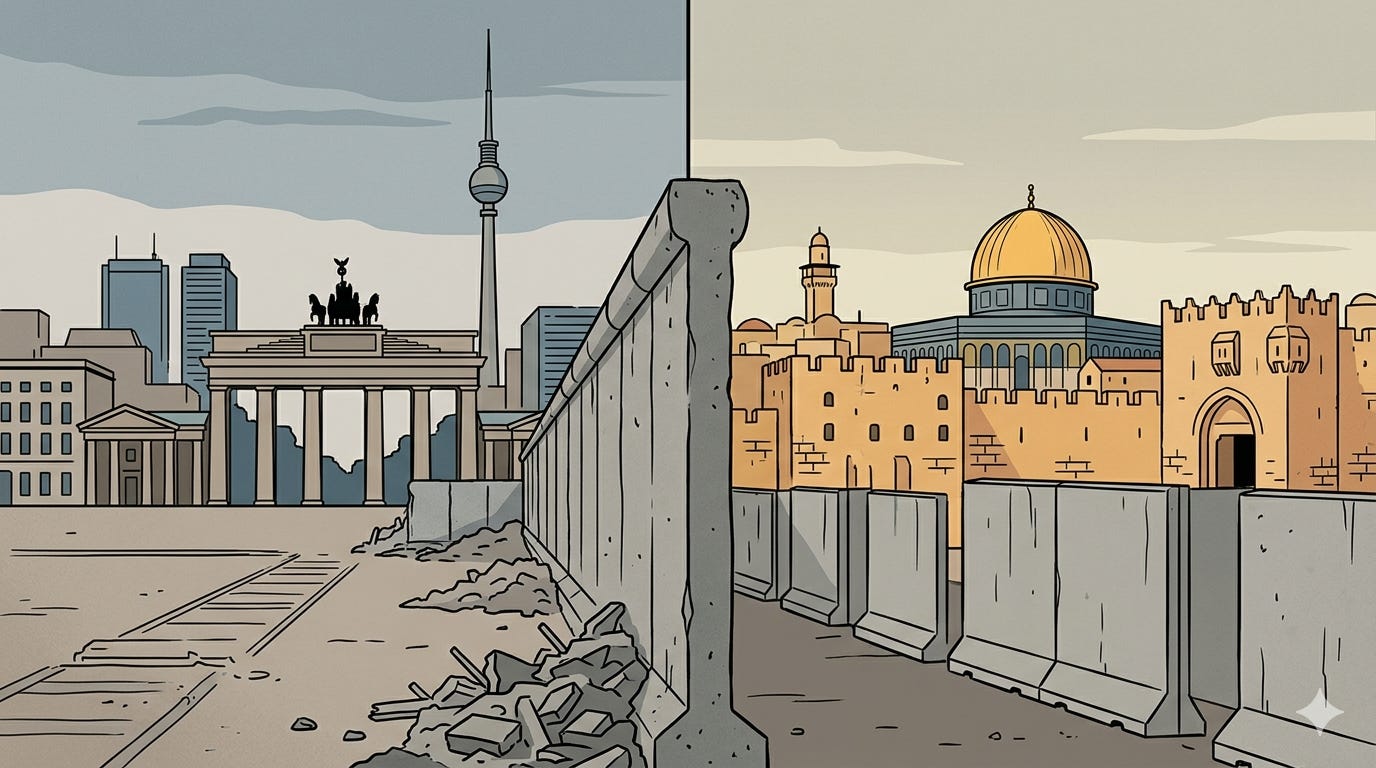
A few years ago, the Governor of Jerusalem told me that his job was among the hardest in Israel. The city, he told me, was a city of thirds: Arabs, ultra-Orthodox Jews, and secular Jews. Each community with its own demands, its own logic, its own claim on the city.
He was right about the arithmetic. Israel’s Central Bureau of Statistics, marking Jerusalem Day this year, confirmed it: Arabs make up 38 percent of the city’s population, ultra-Orthodox Jews roughly 30 percent — which is more than half of all the Jews who live there. What the Governor did not say, perhaps because it is too uncomfortable to say plainly, is that these thirds do not share a city. They occupy the same municipality. That is a different thing entirely.
Since 1967, Israel has called what happened to Jerusalem a reunification. The word does a great deal of political work. It implies a prior wholeness, a natural state interrupted by history and then restored. But a more honest word exists, and international law has been using it for nearly six decades: annexation. On June 28, 1967, three weeks after Israeli forces took East Jerusalem in the Six-Day War, Israel extended its jurisdiction over roughly 70 square kilometers of the West Bank — land that had never been under Israeli sovereignty — and folded it into the Jerusalem municipality. The United Nations General Assembly rejected the move within days, ninety-nine votes to zero.
To understand why the distinction is more than semantic, it helps to look at the one city in modern history that actually did reunify: Berlin.
When the Wall fell in November 1989, Germany faced a genuine reunification — two populations separated for forty years, sharing a language, a history, and an ethnicity, now legally merged overnight. The conditions could not have been more favorable. East Germans received full citizenship immediately. West Germany imposed a solidarity surcharge on its own taxpayers for decades to finance infrastructure in the East. The project had democratic legitimacy on both sides: East Germans voted for unification in March 1990.
And yet. Within years of the Wall’s fall, German sociologists had coined a phrase that captured what political integration could not accomplish: Mauer im Kopf — the wall in the head. The physical barrier was gone; the psychological one endured. East Germans, whose professional credentials and cultural identities were effectively rendered invalid by the terms of absorption, developed a distinct nostalgia — Ostalgie — not for communism, but for a way of life that was now being treated as historical debris. Thirty-five years later, voting patterns in Germany still split along the old border. Preferences for the role of the state, attitudes toward solidarity, even self-reported distances between cities on opposite sides of the former divide: all of them still carry the ghost of the Wall.
If Berlin — with every structural advantage reunification could have — still struggles with a wall in its heads, what does that tell us about Jerusalem?
The comparison is instructive precisely because Jerusalem fails every criterion Berlin met. Arab residents of East Jerusalem were not given citizenship; they received permanent residency, a status that can be revoked and that excludes them from national elections. There was no solidarity surcharge, no systematic investment to bring East Jerusalem’s infrastructure to parity. There was no democratic vote. In fact, historian Amnon Ramon, in his book Residents not Citizens, stated that the Israeli government’s own goal in 1967, according to declassified cabinet protocols, was to maximize territory while minimizing the Arab population incorporated into the new municipal boundaries.
The result is what the data now confirm. According to the Jerusalem Institute for Policy Research, the index of residential dissimilarity between Jews and Arabs in Jerusalem stands at 96 percent — meaning that nearly every Arab resident would have to move for the two populations to be evenly distributed across neighborhoods. Among Jews themselves, the separation between ultra-Orthodox and secular communities reaches 82 percent. Jerusalem is not a city that chose to remain divided despite reunification. It is a city that was never offered the conditions under which integration becomes possible.
The Governor of Jerusalem was describing, without quite saying so, a city of administered separation. Three communities living under one flag, governed by one municipality, but navigating entirely different physical, legal, and social realities. The Arabs cluster in the east, served by underfunded municipal services and cut off, in parts, by the separation barrier. The ultra-Orthodox occupy expanding enclaves in the west, enforcing their own rhythms — streets closed on Saturdays, schools that receive public funding while teaching almost no secular curriculum. The secular population, once the dominant voice in the city, has been steadily leaving for decades.
Berlin’s lesson is not that reunification is impossible. It is that reunification is hard even when done right — with consent, citizenship, and sustained investment. The wall in the heads of Berliners took decades to weaken, and it is only now, thirty-five years on, beginning to fade. Jerusalem never had a policy to tear it down. When none of the conditions of genuine reunion are met, the appropriate word is not reunification. It is absorption. And what has been absorbed, in Jerusalem, is not a missing half of a city. It is a population that was never asked.
Un analisis extremadamente profundo y preocupante. La historia es nuestra mejor herramienta al momento de entender hacia donde vamos y en estos momentos nos encontramos viviendo en un presente en el que esta herramienta se nos hace aparentemente irrelevante. Excelente artículo!
Excelente artículo que pinta de manera precisa que si no se mira a los demás, como dice la biblia, como si fuera uno mismo, es muy difícil obtener resultados pacíficos. Si hay uno que domina y otro dominado la paz siempre estará en peligro. Lo único que puede traerla es la fraternidad humana entre los hombres